Strength Ergometer
Strength Ergometer
₹ 114,406.78 (Exclusive of GST)
Couldn't load pickup availability
- Description
- Additional Information
- Reviews
- FAQ
ATE Strength Ergometer: Air-Resistance Leg Press, Chest Press and Seated Row in One Machine
“Three Strength Stations. One Flywheel. No Weight Plates.”
What is the ATE Strength Ergometer?
It is an air-resistance strength machine from ATE that puts a leg press, a chest press and a seated row on one frame. A fan flywheel supplies the resistance, so the harder you push or pull, the more resistance you feel, and a 10-level damper sets how heavy each rep feels. There are no weight plates or pins to change. It suits home gyms, PT studios, functional training spaces and commercial strength floors, with pan-India delivery and EMI.
The ATE Strength Ergometer is a compact strength machine that replaces the weight stack with a fan flywheel. One frame gives you three stations — leg press, chest press and seated row — so you can train legs, push and pull without changing machines or loading plates.
Because the resistance comes from air, it responds to effort: push or pull harder and the load rises with you, ease off and it drops. A 10-level damper sets how heavy each rep feels, and the resistance acts only on the push or pull, so there is no weight to lower and nothing to drop. That makes it quick to share between users of different strength levels in home gyms, PT studios and group circuits.
Key Features of the ATE Strength Ergometer

Three Strength Stations
Leg press, chest press and seated row share one frame and one flywheel. Move from one to the next in seconds by fitting the push bar, picking up the pull bar or setting the carriage lock.

Air Resistance That Matches Your Effort
A fan flywheel supplies the load. The harder you push or pull, the more resistance you feel — drive it twice as fast and the fan meets roughly four times the air resistance.

10 Damper Levels
Slide the damper from 1 (lightest) to 10 (heaviest) to change how quickly the resistance builds. As a starting point, try 7–10 for leg press, 4–7 for chest press and 1–4 for seated row.

Height-Adjustable Slider, Push Bar & Pull Bar
The slider on the mast locks at numbered heights so the bar lines up with your chest. The push bar for chest press stores in its holder behind the seat, and the pull bar for seated rows sits ready in the slider.

Adjustable Display & Device Holder
Tilt the Bluetooth-enabled monitor to your eye line and track each session in Custom, Time, Distance or Calories mode. A holder at the top of the mast keeps your phone or tablet in view.

Carriage Lock, Rubber Grip Feet & Caster Wheels
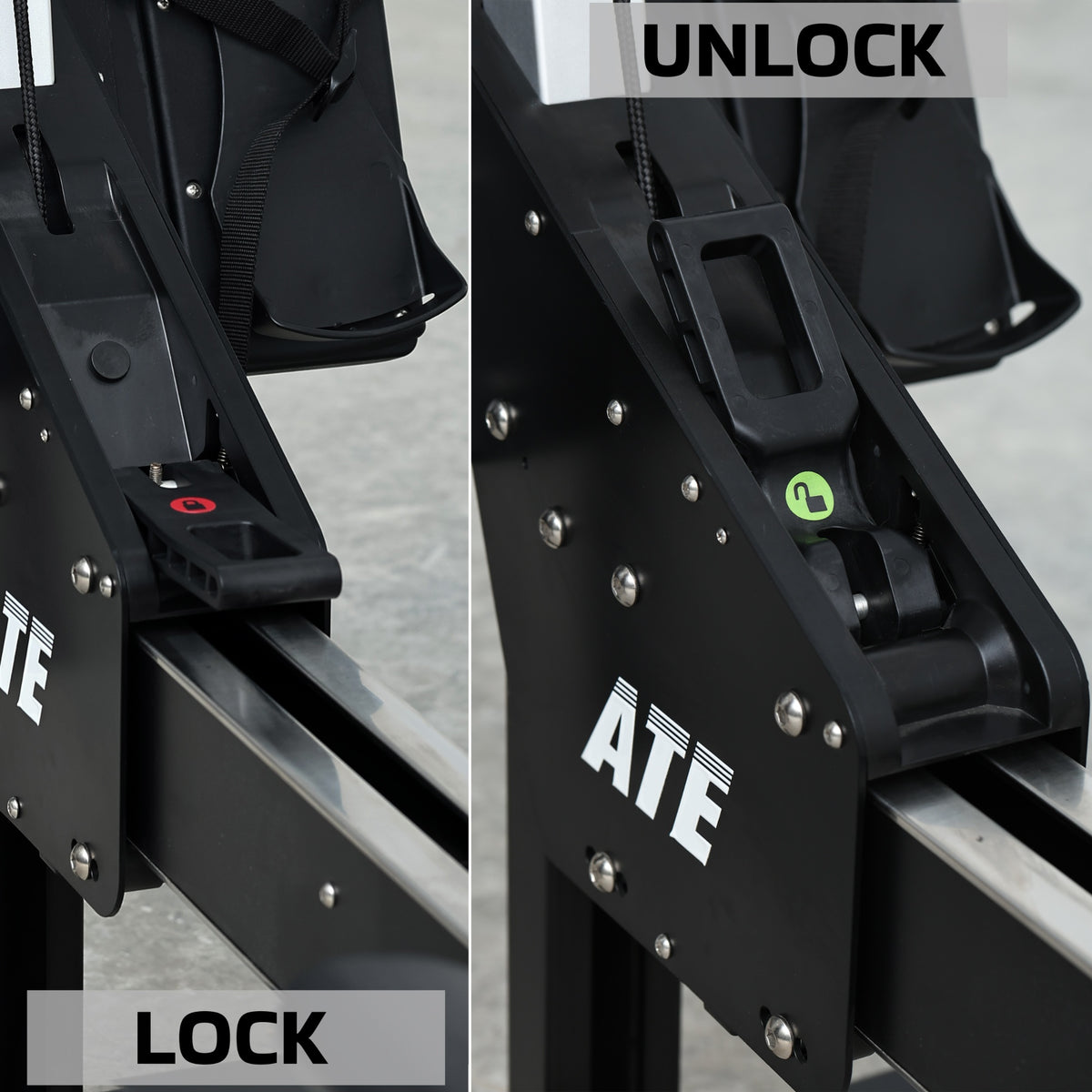
Unlock the carriage for leg press and chest press, and lock it for seated rows. Rubber grip feet hold the frame steady in use, and caster wheels at the flywheel end make it easy to move.
Muscles Worked on the Strength Ergometer -
The three stations cover the main lower-body, push and pull movements:
- Leg press — quads, glutes, hamstrings and calves.
- Chest press — chest, front shoulders and triceps.
- Seated row — lats, upper back (rhomboids and traps) and biceps.
- Core — bracing against the backrest to transfer force on every rep.
Benefits of the ATE Strength Ergometer -
- Full-body strength in one footprint: Legs, push and pull on a single 2160 mm frame instead of three separate machines.
- Resistance that scales with the user: Effort sets the load, so beginners and strong athletes can train on the same setting.
- No plates, pins or stacks: Nothing to load or re-pin between sets or users, which keeps circuits and group sessions moving.
- Load only on the push or pull: The return is unloaded, so there is no weight to lower, nothing to drop and no spotter needed.
- Fine control of intensity: Ten damper levels and your own effort cover everything from light technique work to all-out power reps.
- Easy to place and move: Rubber grip feet keep it planted in use, and caster wheels make it simple to reposition.
How to Use the ATE Strength Ergometer -
Leg press (suggested damper 7 to 10) -
- Unlock the carriage: Lift the latch to the green icon so the footplate slides freely.
- Set up: Sit back against the pad, place your feet on the footplate and bend your knees to about 90 degrees.
- Press: Hold the side grips and press the footplate away, then return with control.
Chest press (suggested damper 4 to 7) -
- Take the push bar: It stores in the holder behind the seat.
- Fit it at chest height: Slide the bar into the slider at the numbered position level with your chest.
- Press: With your back on the pad, feet flat and the carriage unlocked, press the bar away and return with control.
Seated row (suggested damper 1 to 4) -
- Strap in: Place your feet in the footrests and pull the straps snug.
- Press out and lock: Push the carriage away until your knees are almost straight, then lock it.
- Pull: With the pull bar at chest height, pull it to your chest, squeeze your shoulder blades together and return with control.
Sample Strength Ergometer Workouts -
1. Full-body strength circuit
Do 10 leg presses, 10 chest presses and 10 seated rows, each at its suggested damper level. Rest 60 to 90 seconds and repeat for 3 to 4 rounds.
2. Power intervals (12 minutes)
Set the damper in the middle of each station’s range. Do 5 fast, explosive reps at the start of every minute for 4 minutes, then move to the next station.
3. Strength endurance
Drop the damper by two levels and work for 60 seconds at each station at a steady rhythm. Rest 60 seconds and repeat for 3 rounds.
Start at an intensity that suits your fitness and progress gradually. Consult a professional if you have a medical condition.
Strength Ergometer vs Weight-Stack Machines -
| Feature | ATE Strength Ergometer | Typical weight-stack machine |
|---|---|---|
| Resistance | Air (fan flywheel) that rises with your effort | A fixed weight you select |
| Changing the load | Push harder, or move the 10-level damper | Move the pin or add plates |
| Stations | Leg press, chest press and seated row on one frame | Usually one movement per machine |
| Lowering phase | Unloaded, with nothing to lower or drop | Loaded, so the weight must be controlled down |
| Sharing between users | Set the slider height and go | Re-pin or re-load for each user |
| Best for | Home gyms, PT studios, circuits and mixed-ability groups | Strength floors with space for several machines |
Building a full conditioning zone? Pair the Strength Ergometer with the ATE Air Rower Max 1, the ATE Air Ski, air bikes and curved treadmills.
Who Is the Strength Ergometer For?
- Home gyms — three strength stations without racks or weight plates.
- PT studios and small-group training — fast changeovers between clients of different strength.
- Gyms and functional training spaces — a strength station that drops into circuits alongside rowers, skis and bikes.
- New lifters — a simple way to learn the press, push and pull movements with resistance that never exceeds their effort.
Warranty:
ATE Strength Ergometer Specifications:
| Product | ATE Strength Ergometer (air-resistance strength machine) |
| Stations | Leg press, chest press, seated row |
| Resistance System | Air resistance from a fan flywheel |
| Damper Levels | 1 to 10 |
| Monitor | Adjustable-angle display, Bluetooth-enabled |
| Workout Modes | Custom, Time, Distance, Calories |
| Device Holder | Yes, for phone or tablet |
| Slider | Height-adjustable with numbered positions and locking knob |
| Bars | Push bar (chest press) with storage behind the seat; pull bar (seated row) |
| Footplate | Footrests with straps |
| Seat | Contoured seat with side grips and backrest pad |
| Carriage Lock | Yes (lock / unlock) |
| Feet | Rubber grip feet |
| Mobility | Caster wheels |
| Assembled Length | 1700 mm |
| Width | 610 mm |
| Height | 1250 mm |
| Net Weight | 60kg |
| Maximum User Weight | 227kg |
| Warranty | 2 years against manufacturing defects |
Frequently Asked Questions:
What is the ATE Strength Ergometer?
The ATE Strength Ergometer is an air-resistance strength machine with three stations on one frame: leg press, chest press and seated row. A fan flywheel with a 10-level damper supplies the resistance, so there are no weight plates or pins to change.
How does the resistance work on the Strength Ergometer?
Each push or pull spins a fan inside the flywheel housing, and the fan has to move air. The harder and faster you push, the more resistance you feel: air drag rises with the square of speed, so twice the speed gives roughly four times the resistance. The damper, from level 1 to 10, sets how quickly the resistance builds.
Which exercises can I do on the Strength Ergometer?
The three main exercises are the leg press, chest press and seated row. You can vary them with single-leg presses, wide-grip or close-grip chest presses, underhand rows and high rows with the slider raised.
Which muscles does the Strength Ergometer work?
The leg press works the quads, glutes, hamstrings and calves. The chest press works the chest, front shoulders and triceps. The seated row works the lats, upper back and biceps. Together they cover the main lower-body, push and pull muscle groups.
Which damper level should I start on?
As a starting point, try level 7 to 10 for leg press, 4 to 7 for chest press and 1 to 4 for seated row, then adjust to suit your strength. Level 1 is the lightest and fastest, and level 10 is the heaviest.
Is the Strength Ergometer suitable for beginners?
Yes. The resistance only ever matches the effort you put in, so beginners can start gently while advanced athletes push at full intensity on the same machine. Start on a lower damper level and learn each movement before adding speed.
Do I need weight plates or a spotter?
No. The fan flywheel supplies all the resistance, so there are no plates, pins or weight stacks. The resistance acts only on the push or pull and drops as soon as you ease off, so there is nothing to lower or get stuck under.
When should I lock the carriage?
Leave the carriage unlocked for leg press and chest press so it can slide. For seated rows, press the carriage out until your knees are almost straight and lock it, so your legs stay braced while you pull.
How much space does the Strength Ergometer need?
The Strength Ergometer is 2160 mm long. Allow extra room at the footplate end and beside the seat for getting on and off, and use the caster wheels to move it when you need the floor space.
What warranty does the ATE Strength Ergometer come with?
The ATE Strength Ergometer comes with a 2-year warranty against manufacturing defects.
Does ATE deliver the Strength Ergometer across India?
Yes. ATE delivers the Strength Ergometer pan-India, with EMI options at checkout, installation support, and service and spare parts available in India. Gyms and institutions can buy with B2B / GST invoicing.
The delivery time depends on the location of the consignee. The standard shipping time is approximately 8-10 days after the order has been placed.
Yes, we do delivery pan India
Shipping is handled by our expert logistics partners who ensures timely and safe delivery pan India. Different delivery locations are serviced by different logistics partners considering the delivery times across multiple partners.
Installation is done by our team of expert technicians who are located across the country. The technician located nearest to your delivery pin code will be scheduled for installation once the goods have been delivered.
We offer a wide range of commercial and home gym equipment including strength machines, functional trainers, barbells, squat racks, benches, rowers, treadmills, and more.
Yes, our equipment is designed with commercial-grade durability and safety, making it perfect for gyms, fitness studios, and training centers.
Absolutely. We stock spare parts for all our machines and offer easy ordering for components like cables, pulleys, pads, and pins etc.
Yes, flexible payment options and financing plans may be available. Please check at checkout or contact us directly.
Product Gallery